Why Hire a Payroll Company?
Running payroll in-house can feel like the practical choice, especially for a small business. At...

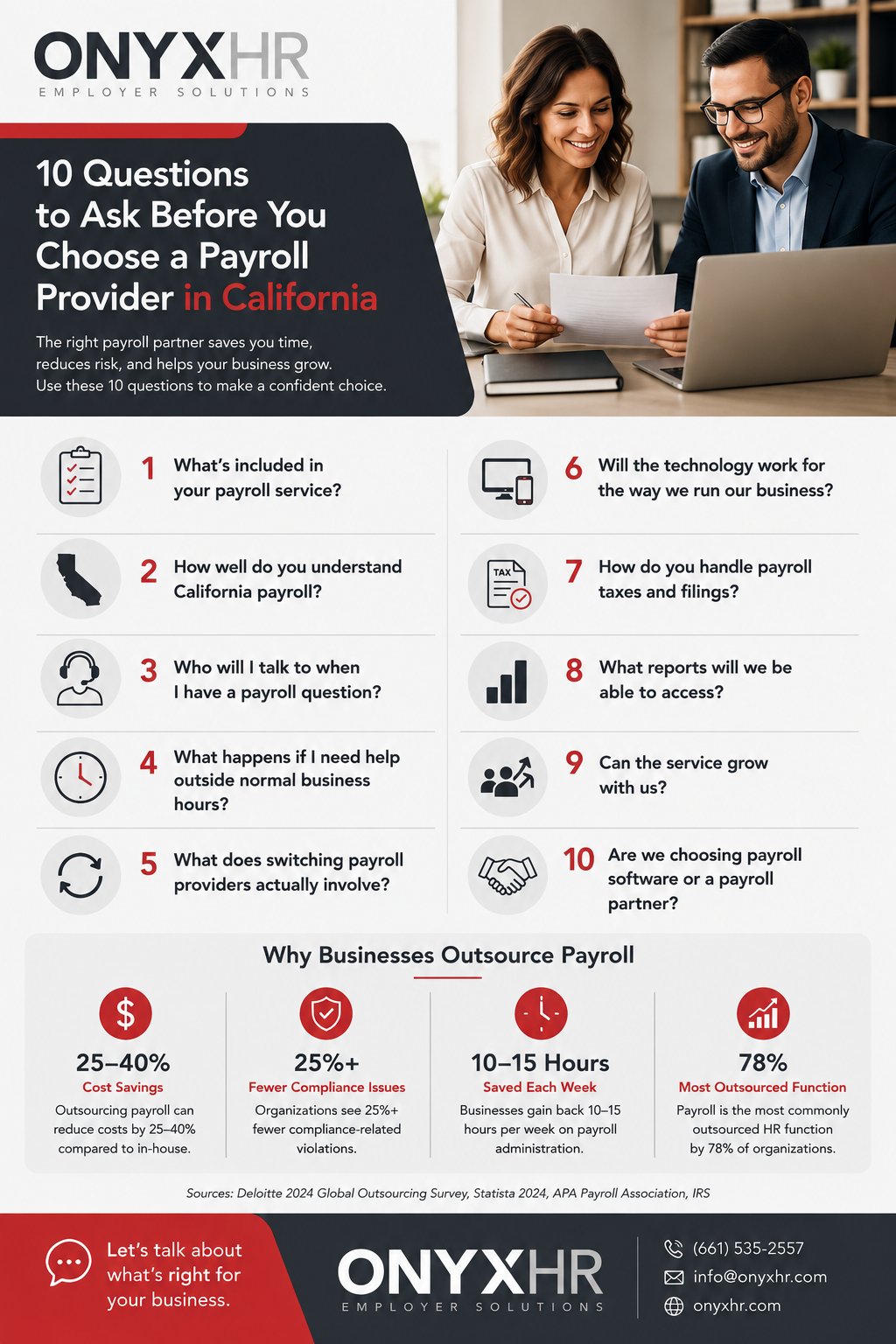
Choosing a payroll provider is about more than finding a company that can process direct deposits every two weeks. Here are 10 questions to ask before you switch payroll providers.
Payroll touches your employees, taxes, timekeeping, onboarding, deductions, reporting and some of the most time-sensitive parts of running a business. Most employers do not think much about payroll when everything is working. When something goes wrong, it can quickly become the most important issue of the day.
At OnyxHR Employer Solutions, we often talk with employers who are considering a payroll change for one of two reasons. They have outgrown their current system, or they are frustrated with the service they are receiving. Sometimes it is both.
California employers also have an added layer of complexity. The state has specific requirements involving paydays, wage statements, payroll taxes, new-hire reporting and final wages. Employers are also required to electronically submit employment tax returns, wage reports and payroll tax deposits to the California Employment Development Department.
If you are comparing payroll companies or wondering whether your current provider is still the right fit, these are 10 questions worth asking before you make a decision.
Start here because the phrase "payroll services" can mean very different things from one provider to another.
Ask what is included in the price you are being quoted. Does the provider handle regular payroll processing, direct deposit, payroll tax calculations and filings? What about quarterly reports, year-end documents, deductions, off-cycle payroll runs and payroll reporting?
Then ask what costs extra.
A low base price may not tell you much if additional payroll runs, W-2 processing, implementation, employee changes or certain support services all come with separate charges.
You do not necessarily need the cheapest payroll provider. You need to understand what you are buying and whether it fits the way your business operates.
A clear proposal should make it easy to see what is included, what is optional and what may result in an additional fee.
For California employers, this should be near the top of the list.
California payroll involves more than calculating gross pay and withholding taxes. Employers have state requirements involving regular paydays, wage statements, payroll records, final pay and other wage and hour matters.
For example, California requires employers to establish regular paydays, and state law specifies when wages must be paid depending on the pay period. Employees must also receive itemized wage statements containing required information.
There are state reporting responsibilities as well. California employers generally must report new and rehired employees to the New Employee Registry within 20 calendar days of the employee's start-of-work date.
A payroll company is not a substitute for legal counsel, and employers ultimately remain responsible for meeting their obligations. But your payroll provider should understand the environment your business operates in and have processes designed with California employers in mind.
Ask how the provider stays current and what happens when a payroll question overlaps with a California compliance issue.

This question tends to become much more important after you have signed the agreement.
A software demonstration can show you what a system looks like. It usually does not show you what happens when you have a payroll problem at 3:30 on a Friday afternoon.
Will you have a specific person or team to contact? Will you call a general support line? Can you email someone who knows your account? Will you work with the same people regularly, or explain your situation to someone new every time you need help?
Ask about response times too.
At OnyxHR, we believe the service behind the payroll technology matters. Employers should know how they can reach their payroll team before an urgent question comes up, not find out after there is already a problem.
A missed deduction, incorrect time entry, unexpected termination or direct deposit issue may need attention quickly. Knowing who you can contact can make a significant difference when time matters.
Businesses do not operate exclusively from 8 a.m. to 5 p.m.
Restaurants have weekend shifts. Construction crews may start before sunrise. Healthcare businesses operate around the clock. Retailers work evenings and holidays. Business owners often catch up on administrative work after everyone else has gone home.
Payroll questions do not always arrive at convenient times either.
One reason OnyxHR places such a strong emphasis on responsive service is simple: employers are not just 8-to-5 businesses, and their payroll provider should understand that.
Ask prospective providers how urgent requests are handled. What communication options are available? What happens if you discover an issue after normal office hours? How quickly should you expect someone to respond?
Not every question needs an immediate answer. But when something truly is time-sensitive, you should know what support is available.
A lot of employers stay with a payroll company they are unhappy with because changing providers sounds like a bigger headache than staying put.
It does not have to be, but the transition needs to be managed carefully.
Ask the new provider to explain its implementation process from beginning to end.
What information will be needed from your current payroll system? Who handles employee records, tax information, deductions, direct deposit details and year-to-date payroll totals? How are balances and prior payroll information checked before your first live payroll?
You should also know who is managing the conversion on the provider's side.
There should be clear deadlines, responsibilities and checkpoints. You should not be wondering a day before payroll whether all of your information made it into the new system correctly.
If you are changing providers in the middle of the year, ask specifically how year-to-date payroll information will be handled.
A good provider should be able to explain the transition in plain language before you commit.

Payroll software can look impressive in a sales presentation. The bigger question is whether your employees and managers will actually use it.
Ask how the system handles time and attendance, employee onboarding, PTO, deductions, payroll reporting and employee information.
What can employees do through self-service? Can they access pay stubs and tax documents? Can they review information without calling your office every time they have a question?
What can managers access?
If you have hourly employees, multiple locations or changing schedules, look carefully at the timekeeping process. Payroll is only as accurate as the information feeding into it.
OnyxHR takes a hybrid approach to payroll, combining payroll technology and employee self-service tools with access to people when a client needs help. Technology should remove administrative work, not create another system you have to figure out on your own.
Do not choose a platform simply because it has the longest feature list. Choose one that makes sense for your employees, managers and administrative team.
Never assume that every payroll provider handles taxes the same way.
Ask exactly what the provider handles and what remains your responsibility.
California employers have recurring payroll tax and wage-reporting obligations through the EDD. Common filings include the Quarterly Contribution Return and Report of Wages (DE 9), the Quarterly Contribution Return and Report of Wages Continuation (DE 9C), and payroll tax deposits.
You should know how those filings are handled and how you can confirm that they were completed.
Then ask one more question: what happens if your company receives a tax notice?
Who reviews it? How do you send it to the payroll provider? If the notice relates to payroll information the provider processed, who researches it and communicates with you?
This is one of those situations where there is a major difference between having payroll software and having payroll support.
Payroll contains a lot of useful information about your business, but only if you can easily get to it.
Ask to see the reporting options before you choose a provider.
Depending on your organization, you may need payroll summaries, department reports, labor distribution reports, deduction information, tax reports, PTO information or reports for your accountant or bookkeeper.
If you use accounting software, ask about general ledger reporting and available integrations.
Also find out how easy it is to retrieve prior payroll information. You should not need to submit a support request every time you need an old report.
If there are reports you rely on today, bring examples to the conversation. Ask the prospective provider to show you how that information would be produced in its system.
Think beyond your next payroll.
A company with 12 employees may have fairly straightforward payroll needs today. Add another location, 30 new employees, different schedules or additional benefits, and those needs can change quickly.
Ask what happens as your organization grows.
Can the provider support additional locations? More complicated timekeeping? Benefits deductions? Retirement plan coordination? Employee onboarding? Additional HR support?
This is an important part of the OnyxHR service model. Businesses should be able to use the level of support they need now and add services as their needs change.
You do not necessarily need a massive package on day one. In many cases, flexibility is more useful than paying for services your company is not ready to use.
The goal should be finding a provider you can grow with rather than repeating the selection process every time your business reaches a new stage.

This may be the most important question on the list.
Technology matters. Employers should expect secure, convenient tools that simplify payroll for administrators and employees.
But software cannot anticipate every situation that comes up when you employ people.
Someone will eventually enter something incorrectly. An employee will have a question. A termination will happen unexpectedly. A tax notice may arrive. A manager will miss a deadline. You may have a situation that does not fit neatly into a drop-down menu.
That is when the difference between payroll providers becomes much clearer.
Some businesses want a primarily self-service experience and are comfortable navigating most issues through software and centralized support.
Others want the efficiency of modern payroll technology with the ability to call someone who understands their business.
Neither approach is automatically right for every company. What matters is knowing which one you are getting before you sign an agreement.
It is easy to compare payroll providers by price.
It is easy to compare feature lists.
Service is harder to put into a spreadsheet, but it can have just as much impact on your experience with a payroll company.
Ask who answers the phone. Ask about response times. Ask what implementation really looks like. Ask how California payroll requirements are handled. Ask what happens when something goes wrong. Ask whether the provider can support the business you expect to become, not just the business you are today.
At OnyxHR Employer Solutions, we combine payroll technology with responsive, human support for California employers. Payroll processing, tax filing, time and attendance, onboarding, employee self-service and additional HR support can work together based on what your organization actually needs.
You get technology that makes payroll easier, backed by people you can reach when you have a question.
If you are evaluating payroll providers or wondering whether it may be time for a change, contact OnyxHR Employer Solutions to talk through your current payroll process and what you would like to improve.